

The Narrowboats that Circled the World

The Whitchurch canal breach in December 2025 became a worldwide social media sensation almost overnight. Why did it go viral, circling the world from France to Japan, and does the attention generated offer any hope for the future of Britain’s underfunded waterways?
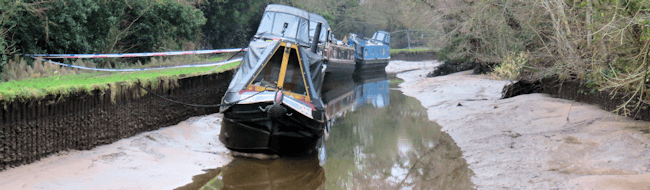
Dried out narrowboats near the breach – image courtesy of Jim Forkin, IWA
Going Viral
Canal embankment collapses happen an average of four or five times a year in Britain. They rarely make the national news, let alone international media. So why did an embankment breach in Shropshire, last December 22nd become a worldwide story? The short answer is social media, but the longer answer is more interesting.
The breach at Whitchurch ticked almost every box for a viral event. It was live and unfolding. Anyone nearby with a mobile phone, or their teenager’s Christmas drone, could broadcast breaking news to a global audience without waiting for professional journalists. Some descriptions were wild and some claims dubious, but that only added to the excitement, and quickly attracted the attention of mainstream press and television, which is how editors now find stories.
It had compelling human interest at its heart. People who live on narrowboats, an already intriguing lifestyle to most audiences, had their homes sucked into a black, watery ‘sinkhole’ in the middle of the night. Fifteen ‘livaboards’ were evacuated, seven boats were affected. Nobody was killed or seriously hurt, but the drama was vivid and personal: the kind of story social media describes as ‘ordinary people to whom extraordinary things happen’.
And crucially, it kept running. The story had a continuing narrative over weeks and months: the canal being dammed, survivors giving their accounts, a crowdfunding appeal raising over £100,000 for emergency support, the painstaking recovery and refloating of the stranded boats, and the prospect of a full rebuild by the end of the year. Social media algorithms reward exactly this kind of ongoing story, every new development feeds engagement, lifts the post and widens the audience.
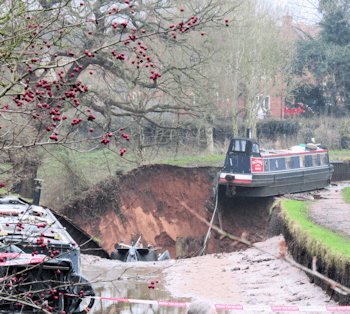
Narrowboat overhanging the breach – image courtesy of Jim Forkin, IWA
Drones, Machines and ‘Notsperts’
Social media also hungers for striking visuals, and Whitchurch delivered. Within hours of the collapse a flock of drones were in the air surveying the full scale of the damage: acres of displaced mud and twisted steel piling, flooded fields, and narrowboats like toys, tossed at impossible angles. One early clip, an eerie night-time shot of a narrowboat being drawn down into the gurgling dark water, just like the Titanic, became one of the most-shared videos of the event.
Then came the machinery. There’s a devoted following for heavy engineering equipment on Social media, and the recovery operation provided weeks of content: enormous water pumps with heavy piping snaking across the fields; specialist off-road cranes; heavy tracked winches; and a ‘spider excavator’, with four large wheels on flexible arms allowing it to step in and out of the drained canal at will. Hours of aerial footage, machines crawling slowly amongst their hi-vized attendants, attracting audiences that would make any television producer envious.
Alongside the video, hundreds of comments and conversations flourished, some heated. What caused the breach? How should it be repaired? What should be done with the stranded boats? How should the crowdfunding be shared? On social media, everyone is an expert. The more the ‘notsperts’ argue and respond, the more the algorithm distributes the posts to new viewers; a self supporting cycle ensures a Shropshire canal collapse ends up being ‘big in Japan’!
The Bigger Picture: Funding and the Future
Beneath the drama, the Whitchurch breach reignited a serious debate about the long-term condition of Britain’s canals. Even the Canal and River Trust (CRT), the charity which manages the waterways, had been warning that chronic underfunding meant some canals may need to close to be able to afford to keep the rest operating safely. Its annual maintenance budget currently stands at £52.6 million but within ten years that government funding will fall to £31.5 million, a cumulative loss of £300 million.
Critics argue underfunding has already decimated staffing levels. In 1980, British Waterways (CRT’s predecessor) employed around 3,000 people, many of them career engineers and experienced local workers with deep knowledge of their stretch of canal. CRT now employs around 1,600, supplemented by nearly 5,000 part-time volunteers. The charge that this leaner, more centralised workforce has replaced planned maintenance with crisis response is hard to dismiss when emergency repairs like this £6–7 million rebuild must be paid from an already insufficient budget.
Could CRT save money by using modern technology to replace local workers and skills? Since 2004 it has been gathering data on historic breaches into a National Breach Archive and deployed modern monitoring technology: an inspection-based risk analysis system was introduced for embankments in 2013, and a network of 600 water-level monitoring stations with automated alerts installed to warn engineers of unusual water flow rates. Whether either system flagged Whitchurch as high-risk before December 22nd is a question that deserves a clear public answer. And is there any evidence that they have reduced the rate of breaching since 2013?
Has Going Viral Helped or Hurt?
The viral coverage of the Whitchurch breach might appear to have produced some tangible results: a £6.5 million government grant to improve canal resilience against climate change was recently announced. But apparently this was allocated before the breach. A CRT public fundraising appeal was launched to help fund the repair with unknown results. Certainly, more people in Britain now know that their canal network is under financial strain than did before the Whitchurch breach. That increased awareness of the fragility of the system is probably the most visible outcome.
But even that has risks. Constant crisis coverage can breed ‘habitualisation’, a slow acceptance that closures, failures and deterioration are simply the ‘new normal’. After a second successive cruising season disrupted by water shortages and emergency engineering works, many boaters and canal businesses are already uncertain about their futures. If every summer brings fresh headlines about the canal system’s problems, those problems may come to feel inevitable rather than solvable, making it easier, politically, to let the network quietly decline.
The narrowboats which went viral from field near Whitchurch were watched by millions of people around the world. The question now is whether any of them will still be watching, and pressing for change, after the cameras move on.
Some data on Canal Breaches taken from ‘Canal breach risk assessment for improved asset management’ Dun and Wicks, Proceedings of the Institution of Civil Engineers 2014, http://dx.doi.org/10.1680/wama.12.00060
All materials and images © Canal Junction Ltd. Dalton House, 35 Chester St, Wrexham LL13 8AH. No unauthorised reproduction.
About
| Terms
| Privacy |
Returns |
Sitemap
| Contact Us
Web Hosting & Development
With over 800 pages, this website uses cookies to record visitor behaviour using Google Analytics. More information on Privacy Page. Page last updated: 16/03/2026.