

Canal Locks and Canal Lifts; canals climbing hills
Locks were the essential canal engineering feature, allowing canals to climb over ranges of hills and create coast-to-coast inland waterway links.
Narrow and Broad Locks.
Locks are an essential feature of any canal which needs to gain or lose height. A few canals have no locks, such as the Ashby Canal and the Gloucester and Sharpness Canal – although it does have locks at both ends.
Locks were built to two main sets of dimensions, known as narrow locks and broad locks, though there are many locks with larger dimensions, especially on the river navigations. Narrow locks take one narrowboat which was up to 72 feet long and 7 foot beam. Broad locks may be designed to fit two narrowboats side by side as at Hatton on the Grand Union Canal on the right, or may be designed for barges of about 65 foot long and 14 foot beam, as on the Leeds & Liverpool Canal.
Most locks are between 6 and 10 feet deep but Tardebigge Top Lock on the Worcester and Birmingham falls 14 feet and the rebuilt Tuel Lane Lock on the Rochdale Canal is 19 feet deep!
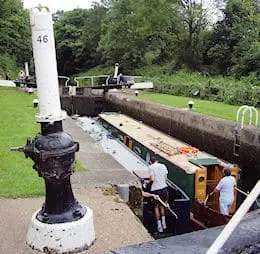
Staircase locks and Flights of Locks
Early canals placed locks wherever there was a contour change in the landscape, so that the canal channel could be built as easily as possible, and the spacing between locks varied greatly. It was cheaper to build staircase locks which shared gates, such as the the Watford Locks on the Grand Union Leicester Line, if there was a sudden change in contours which needed a few locks very close together.
When canal engineering developed to construct cuttings and embankments it became possible to decide where to put locks. It was more convenient for construction and for operation to put a number of locks together in a flight. Flights of locks on UK canals can contain anything between 3 and thirty locks!
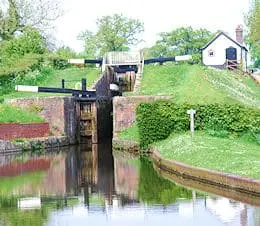
The Caen Hill Flight on the Kennet and Avon Navigation has 29 locks and the Tardebigge Flight on the Worcester and Birmingham Canal has 30 locks. Quite a good morning’s work!
Duplicate Locks and Stop Locks
As canals became busier many single flights of locks created bottlenecks. More profitable canals, such as the Trent and Mersey Canal at Church Lawton and on the Ashton Canal, built duplicate locks alongside the existing ones. When boats were worked in pairs they could be worked side by side through the locks.
Stop locks were built where canals joined to keep the water belonging to the two canal companies separate, Water was a valuable commodity! They had a very small fall, as at Dutton on the Trent and Mersey Canal near it’s junction with the Bridgewater Canal and Sutton Stop near Hawkesbury Junction where the Coventry Canal meets the Oxford Canal.

Canal Lifts and Canal Inclined Planes
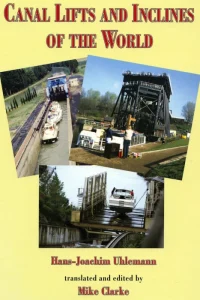
Many alternatives to locks were tried out by the canal engineers, eager to reduce the loss of water during lock operation, (about 50000 gallons for a narrow lock) and to save the costs of lock construction.
Inclined planes usually had rails on which tanks containing a boat could be pulled up from one canal level to another. There are the remains of one at Foxton on the Grand Union Canal.
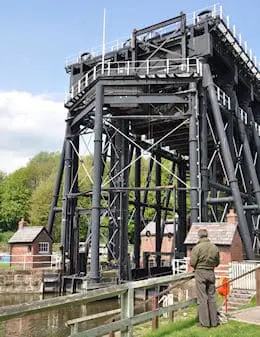
Canal lifts, like the one at Anderton on the Trent and Mersey Canal on the right, lift boats vertically, usually in a water filled tank. Anderton has two tanks which can each take two narrowboats and lift 50 feet from the River Weaver to the canal. Originally the two tanks counterbalanced each other and were hydraulically powered. Electric motors were installed early in the last century and weights and pulleys were added to enable the tanks to operate independently. It was closed in the 1980’s due to corrosion but has been fully restored and reopened in 2002, reverting again to hydraulic power. More recently the Falkirk Wheel on the restored Scottish Lowland canals takes the form of two counterbalanced caissons on rotating arms which lift boats 115 feet (35 metres).
All materials and images © Canal Junction Ltd. Dalton House, 35 Chester St, Wrexham LL13 8AH. No unauthorised reproduction.
About
| Terms
| Privacy |
Returns |
Sitemap
| Contact Us
Web Hosting & Development
With over 800 pages, this website uses cookies to record visitor behaviour using Google Analytics. More information on Privacy Page. Page last updated: 27/10/2026.
Back to Menu....
Canal Heritage >>
Engineering >>