

Canal Narrowboat Art – Roses and Castles
Roses and Castles has become the popular generic name for the naturalistic and pictorial elements of the traditional paintwork of the narrow canal boats. When we speculate about the origins of this unusual – in Britain – decorative art, we must not just think of rose patterns and castle pictures. They certainly form the bulk of the tradition that we have inherited and revere in the late twentieth century, but they were part of a broader scheme.
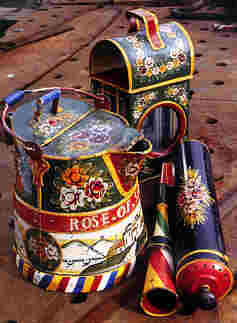
There certainly are roses of a sort in profusion, but there are also daisy-cum-marigold shaped flowers, dahlia/ chrysanthemums, pansy/primroses and other strange floral hybrids invented by the brush of the painter working at speed. Castles or big country houses predominate in the picture panels, but there are also churches, cottages, lighthouses and portraits of dogs, horses and the sailor’s head from Players cigarette advertisements. The earliest written reference to narrow boat painting in 1858 describes it as in … “the style of the great teaboard school of art“, the sort of common commercial work that decorated cheap tin trays and trinkets, what we might today disparagingly term ‘chocolate box art’ catering for undiscerning popular taste.
In 1873 another journalist says the landscapes are usually river scenes, very naively painted but … “whilst the tree might stagger a botanist … the whole serves its first purpose as a decoration, which our more pretentious art so frequently misses“.
And it certainly did decorate, nearly everything. The drinking water can on the cabin roof was painted and decorated, as was the wash basin, cabin stool, headlamp, bucket and the horse’s feed tin. Pictures and posies adorned the walls inside the cabin, the built-in furniture and the little doors that led into it. On the most elaborately decorated craft the painted decorations spread all over the outside of the boat and its equipment as well, entwined with the lettering on the cabin side, on the rudder and on the gang plank supports. Roses even appeared on the horse harness.
Commercial pressure has played a large part in shaping the present tradition, a balance between what was desired and what could be afforded, what could be produced for the available money.


One of the perverse pleasures of the Roses & Castles tradition is its Mysterious origin.
Nobody really knows where it came from. There have been plenty of suggestions and speculation, but no hard evidence. It may be a leftover Victorian commercial art nurtured by the anachronistic culture of the canals to survive as an exotic species in the modern world, but it could equally possibly be a foreign implant. There are vaguely similar styles of folk art in Scandinavia and Germany, and surprisingly similar styles in Turkey and Bangladesh. In the eighteenth century the apparently related Hinderloopen paintwork of the Dutch was only a sailing barge journey away from the Thames, whilst many people recognise a connection with the Gypsies’ culture and their elaborate caravans. It is still a mystery. Whatever the origins this most delightful of British folk arts is surviving quite well, and still giving pleasure. Old examples are now treasured and displayed in several museums devoted to canal life and history, and a new breed of painters carries the tradition forward on the cabins and water cans of the new breed of canal users, who now preserve the waterways as a leisure industry.

What the boat people desired was intricacy, an illusion of riches, an obvious extravagance of pattern and texture to counteract the actual paucity of their possessions. What the painters provided was a fast technique for painting floral sprays and romantic landscapes to order, in profusion, on any object or in any space available.
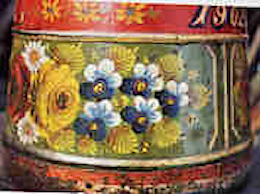
Flower painting was reduced to a formal system of decorating things with a floral effect, simple roundels of background colour worked up with a few brushstroke petals to suggest roses or daisies, nestling in an enclosing pattern of leaves.
Castle pictures were built with a few simple ochery-cream towers painted against a background of clouds, sky and distant misty mountains created with a few brushstrokes of blended blue and white. Greens and browns were brushed into a foreground garden, finished with a mass of feathery trees and bushes. There might be a bridge, fences, swans or sailing boats, just as the artist fancied (or his skill allowed) but the confidence gained by regular practice usually ensured a brash charm to the handling of the paint.
In many cases the attractiveness of the art is largely due to the polished slickness of the commercial technique.

All materials and images © Canal Junction Ltd. Dalton House, 35 Chester St, Wrexham LL13 8AH. No unauthorised reproduction.
About
| Terms
| Privacy |
Returns |
Sitemap
| Contact Us
Web Hosting & Development
With over 800 pages, this website uses cookies to record visitor behaviour using Google Analytics. More information on Privacy Page. Page last updated: 16/10/2025.
Back to Menu....
Canal Heritage >>