

Canal Narrowboat Art – Narrow boat decoration
The most powerful visual impression made by a traditionally decorated narrow boat is of colour – lots of colours carefully contrasted in tone, painted all over the boat in increasing layers of complexity. Where did it all come from, perhaps from sea going ships and boats, maybe from road vehicles and farm carts? Or maybe just from common symbols and decorations of the day.
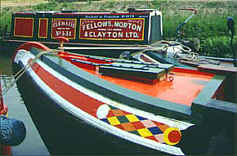
The basic stage is simply picking out the physically separate parts of the craft in different colours, the deck red and the hatches green for example. The main panel on the outside of the cabin carrying the signwriting will be one colour whilst the boards and mouldings that frame it will be another. Little artistic judgement is required beyond choosing the colours, for they simply follow the boundaries of each separate part of the boat, although this seemingly mundane treatment is pursued to an exceptional degree on canal boats.
The next stage is far more peculiar however, for the boat tradition seems to have absorbed designs from several origins to create its own new language of decoration. The plain flat sliding hatch, for example, that covers the cabin entrance might carry a heart, a circle or a playing card club design painted in red on a white or yellow background, bordered by a scalloped edge of green or blue. Did they ever have any deep symbolical significance, or have they always just been a jolly pattern, with friendly overtones of good luck?
The back of the cabin usually bears a variation of an ogee arch shape painted in two or three colours, a symmetrical curving design rising to a point in the middle, on the line of the cabin doors.

It is reminiscent of the chamfering patterns on old farm carts, but how did it arrive on the boats to look so right? Any rectangular surface is likely to be divided by diagonals into four painted triangles of colour, whilst the end of the central gangplank and a wide band down the centre of the cabin roof might carry a harlequin plaid of coloured diamonds. Six petalled compass patterns and crescent moons abound, and masses of diamonds, scrollwork and painted borders can be added almost indiscriminately. Even before the signwriting, roses and castles or scrubbed white ropework are added the boat is vibrant with painted patterns and textures.

Where on earth did they all come from? It seems improbable that the whole mess and pottage derives from one source.
Sea going ships and sailormen might provide part of the answer, for some of the constituents of the narrow boat convention do seem to be exaggerated versions of nautical practice. The bow and stern of almost every vessel of the world carries some sort of insignia, from the elaborate figureheads and cherub-encrusted galleries of the gilded men-of-war of the past to the simple emblematic eyes and stars on the front of humble modern fishing boats. The painted designs on the top planks of the narrow boat hull at stem and stern certainly seem to echo that ancestry, perhaps through the regional barges of all the rivers that were connected together by the inland canal system of the eighteenth century. They would all have had their own local traditions of colour and style which in turn would have influenced the style of the new canal boats.
But the colours and chamfer patterns of road vehicles and farm carts seem equally influential, and as research has shown that many of the early boatmen had previously been farmers and carters, a rural connection seems probable as well. Add to all that the boatwoman’s domestic instincts, her distillation of all the outward signs of house dwelling respectability into a miniature parlour on the move, and the result was a wonderfully fertile field for the development of the folk art tradition of the canal age.


All materials and images © Canal Junction Ltd. Dalton House, 35 Chester St, Wrexham LL13 8AH. No unauthorised reproduction.
About
| Terms
| Privacy |
Returns |
Sitemap
| Contact Us
Web Hosting & Development
With over 800 pages, this website uses cookies to record visitor behaviour using Google Analytics. More information on Privacy Page. Page last updated: 23/10/2026.
Back to Menu....
Canal Heritage >>