

Yorkshire canal boats and Humber Keels.
The network of waterways in Yorkshire and most of the rivers running down to the Humber ports favoured massively built round bilged barges whose bows were so bluff as to be almost flat fronted. Fitted with leeboards and driven by a big single square-rigged sail they were known as ‘Humber Keels’.
Humber Keels
Many details of their construction suggest that these fat regional wooden workboats were actually close relatives of the Viking long ships that invaded this coastline a thousand years ago.
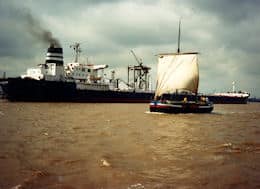
Unfortunately there are no complete wooden examples left (except the Guidance, converted to a houseboat in Shoreham in Sussex) but there are a number of later iron-built cousins afloat, including the Comrade, which is kept in commission in full sailing trim. The Amy Howson is also kept in full working order by the same preservation society, and although of a similar hull shape she is rigged ‘fore and aft’ and therefore classed as a ‘Humber Sloop’. These little ships, as well as the many big steel working barges in the area clearly show their old sailing keel ancestry. Working inland the same craft could lower their sailing gear, or de-rig and leave it behind, and be towed behind a horse or a tug.
Yorkshire Canal Keels
Up country in the smaller canals of West Yorkshire a fleet of smaller wooden canal keels were developed, and some motorised ‘West Country‘ wooden keels were still at work into the 1970s, but they too have now stepped back into history.

Only one survives as this is written, the Gwendoline, sunk awaiting possible restoration at the National Waterways Museum at Ellesmere Port in Cheshire
Tom Pudding trains
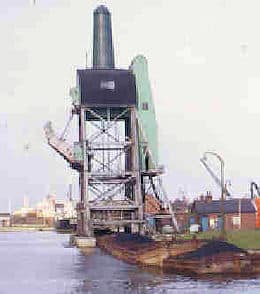
One startling innovation on the Aire and Calder Navigation was the development in the 1860s of the ‘Tom Pudding’ trains. These were long lines of big floating boxes, or skips, each carrying about 40 tons of coal. When joined closely together and towed by a tug they formed one long flexible barge but on arrival at Goole docks the train was disconnected and each container was raised out of the water individually by a huge hydraulic lift and tipped into a waiting coasting collier. Although this original system was finally discontinued in the 1980s (and only five old containers and one ’jebus’ bow section remain afloat) the concept stayed in operation for a number of years using much bigger containers, moved by modern push tugs in rigid lines of three to Ferrybridge power station. Each one-man tug could push about 500 tons.

 The idea was not new even in 1860. The Shropshire tub boat canals built in the 1790s were also designed for trains of floating boxes, but in that case each box could only carry about 5 tons. Even so, one horse could still pull a train of eight or ten containers, with the boatman keeping the front box out in deep water with the aid of a long boat hook.
On the colliery canals around Manchester the boxes themselves weren’t waterproof, but were loaded ten at a time onto a specially built narrow boat. On arrival at their destination the boxes were hoisted out and their coal cargo was released through hopper doors in the box bottom. The only complete example of this old style of boat is to be seen at Ellesmere Port.
That too was a modern development for its time for the earliest boats on the Bridgewater Canal working deep into the Duke of Bridgewater’s mine at Worsley in 1760, were loaded with baskets of coal, dragged from the coal face to the boats inside the mine, and unloaded in Manchester with the aid of a water powered hoist.
All materials and images © Canal Junction Ltd. Dalton House, 35 Chester St, Wrexham LL13 8AH. No unauthorised reproduction.
About
| Terms
| Privacy |
Returns |
Sitemap
| Contact Us
Web Hosting & Development
With over 800 pages, this website uses cookies to record visitor behaviour using Google Analytics. More information on Privacy Page. Page last updated: 17/10/2025.
Back to Menu....
Narrowboats & Barges >>
Canal Heritage >>