

Mersey Flats, Weaver Packets and Dukers
The characteristic carrying craft of the waterways linked to the Mersey estuary were the Mersey ‘Flats’, deep sided barges about seventy feet long by fourteen feet wide.
By the time the Duke of Bridgewater started building his innovatory canal from his mines in Worsley to the market at Manchester in the 1760’s various shapes and sizes of sailing flats were already at work in the area, on the Mersey and Irwell Navigations, the River Weaver, River Dee and the Sankey Brook Canal. The Duke therefore sensibly designed his canal extension from Manchester to Runcorn to accommodate these local boats, and his flight of locks at Runcorn effectively set the gauge for the area’s later interconnecting waterways, the Rochdale Canal, the Chester Canal and, much later, the lowest Liverpool section of the Leeds and Liverpool Canal.
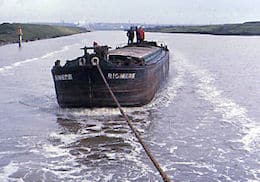
‘Flats’
Mersey Flats were originally carvel built round-bilged round-sterned sailing barges, with a single mast rigged fore and aft with a gaff mainsail and large jib to the stem head. Masts could be lowered or lifted out for upriver work. A few bigger ones, the ’Jigger Flats’, were fitted with a mizzen mast and ventured out to sea as small coasters, to Wales and the Furness Peninsular.
Canal flats were built with the same general hull characteristics, but were unrigged, designed to be pulled by horses or tugs, but still strong and seaworthy enough to navigate the Mersey estuary to the docks at Liverpool.
The earliest River Weaver flats were rather smaller transom sterned barges, but steady improvements to the river and the prosperity of the Cheshire salt trade led to the eventual development of a class of much bigger steam powered flats, the Weaver ‘packets’

‘Packets’
Weaver Packets were capable of towing one or two more dumb flats behind them. In the 1890’s the new docks of the Manchester Ship Canal offered more work for Mersey flats, lightering goods out of the ships into the local canals.
A new class of motorised steel barge was built by the Bridgewater Canal Company as late as the 1950’s for this work, and this ‘Duker‘ fleet of power barges and dumb lighters only finished carrying to Kelloggs in 1974.
The Bigmere is now on display at the National Waterways Museum at Ellesmere Port, and a number of the motor barges now serve as handsome houseboats in the area.

However, most of the classic wooden flats had been taken out of service long before that. Some were broken up, but many were sunk out of the way in side basins at Runcorn and Chester and on the River Weaver. Only two now remain as representatives of a bygone class of thousands, the bluff-bowed Oakdale last seen up the Cumbrian coast, and the more graceful canal flat Mossdale at the Ellesmere Port museum.
Neither ever worked under sail (although the Oakdale was sometimes rigged to look as of she did) but the Mossdale preserves the details and lines of her sailing cousins very well. She is now very old indeed for she was built originally as the Ruby for the Shropshire Union Canal in the 1870’s and remained with them until they finished carrying in 1921.
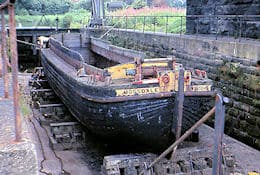
Mossdale is one of the most important historic craft in the North West of England, and although in the care of the museum, and thus safe from immediate destruction, this fine little ship is in desperate need of much serious and expensive restoration work. At present there is little prospect of this money being found, and she continues to deteriorate.
All materials and images © Canal Junction Ltd. Dalton House, 35 Chester St, Wrexham LL13 8AH. No unauthorised reproduction.
About
| Terms
| Privacy |
Returns |
Sitemap
| Contact Us
Web Hosting & Development
With over 800 pages, this website uses cookies to record visitor behaviour using Google Analytics. More information on Privacy Page. Page last updated: 24/10/2026.
Back to Menu....
Narrowboats & Barges >>
Canal Heritage >>